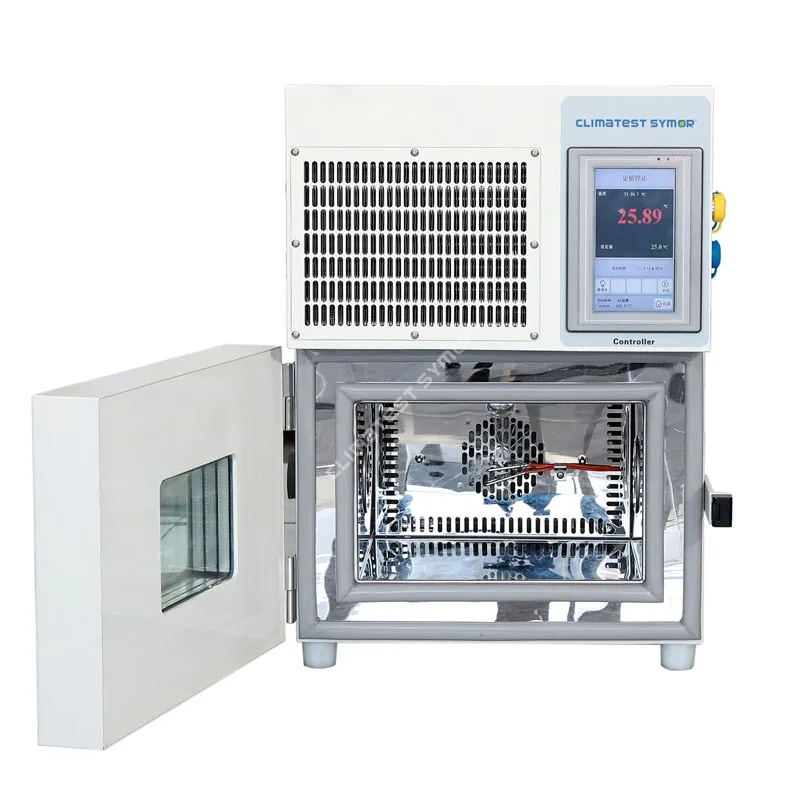
A Small Temperature Test Chamber delivers the exact same thermal stress screening capabilities as floor-standing temperature chamber, but within a footprint that fits on a benchtop or in a crowded lab.
The challenge is that "small" does not mean "weaker." The compact mini temperature test chambers achieve temperature ramp rates of 3°C to 5°C per minute while consuming less than 1.5KW power. This guide provides a complete technical breakdown of Small Temperature Test Chamber specifications, including performance tables, mechanical structure, and pratical application advice.
Core Technical Specifications of a Small Temperature Test ChamberWhen evaluating a Small Temperature Test Chamber, you cannot rely on marketing hypes. Professional clients ask for data. Below are the standard specifications for high-performance compact temperature test chambers ranging from 12 liters to 36 liters of internal volume—the most common sizes for component-level testing.
| Parameter | Standard Range | Engineering Note |
| Internal Volume | 12L / 22L / 36L | 12L suits single PCB or battery cell testing. 36L accommodates up to 3 automotive sensors simultaneously. |
| Internal Dimensions (W x D x H) | 310×230×200 mm (12L) to 400 x 300 x 300 mm (36L) | Ensure your device under test (DUT) does not occupy more than 2/3 of the internal area to maintain airflow. |
| External Dimensions (W x D x H) | 500×540×650 mm (12L) to 640×730×920 mm (36L) | Most units are designed to fit laboratory benches. |
| Net Weight | 60 kg to 90 kg | Verify your workbench load rating. |
| Interior Construction | SUS 304 stainless steel | Provides oxidation resistance and allows for easy cleaning |
| Exterior Construction | Powder-coated cold-rolled steel | Rust resistant, stable property |
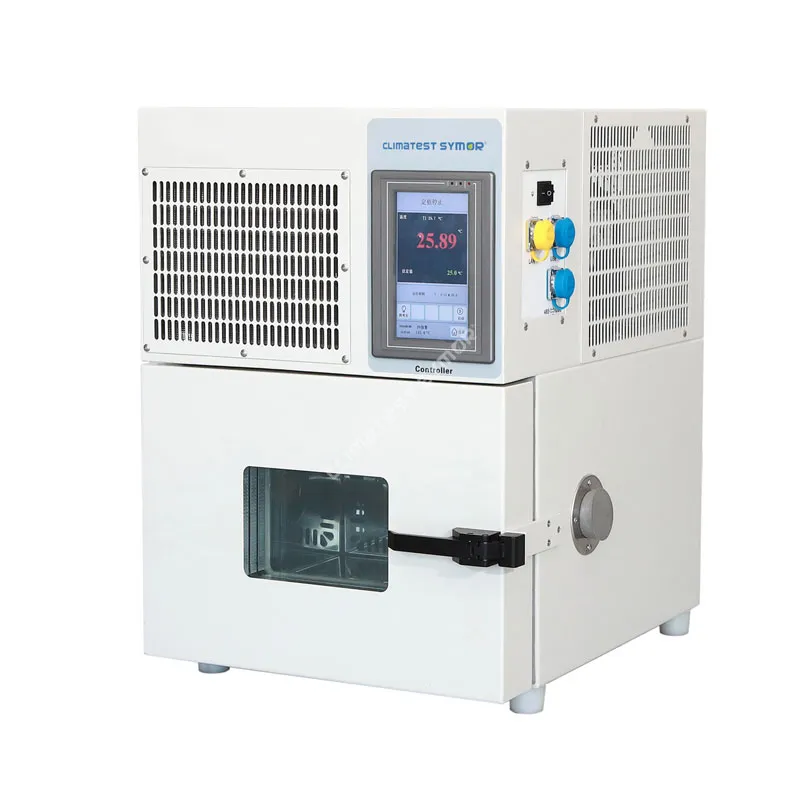
The specifications in this table determine whether your Small Temperature Test Chamber meets international test standards such as IEC 60068-2-1 (cold) and IEC 60068-2-2 (dry heat).
| Parameter | Value (Standard Model) | Critical Insight |
| Temperature Range | -40°C to +130°C | -40°C covers 95% of commercial electronics testing. |
| Temperature Fluctuation | ± 0.5°C | Measures short-term stability at a single sensor point. |
| Temperature Uniformity | <2.0°C (@9 points) | No load |
| Heating Rate | 2.0-3.0°C/min average | From -40°C to +85°C |
| Cooling Rate | 1.0-2.0°C/min average | From +85°C to -40°C. Limited by compressor displacement at low temperatures. |
| Temperature Resolution | 0.1°C | High resolution is essential for stability testing of MEMS sensors and oscillators. |
A Small Temperature Test Chamber is normally integrated into your existing workflow, data systems, and physical environment.
Air Circulation System
All modern compact chambers use a forced-air convection design. A centrifugal fan mounted on the rear wall draws air across a finned heater and evaporator coil, then distributes it vertically through perforated side ducts. The air velocity should be between 1.5 m/s and 3.0 m/s. Higher velocities improve uniformity but can cool small, lightweight samples faster than the programmed ramp rate.
Cable Port and Accessories
Every Small Temperature Test Chamber must include a side access port. The standard diameter is 50 mm (2 inches). The port includes a silicone rubber plug that maintains the chamber seal while allowing wires to pass through. For powered DUTs, use the cable port exclusively—never close the door on cables.
Shelves and Load
Standard mini temp chamber include one stainless steel shelves. Maximum shelf load typically ranges from 10 kg to 20 kg, with the bottom shelf rated for the full chamber capacity.
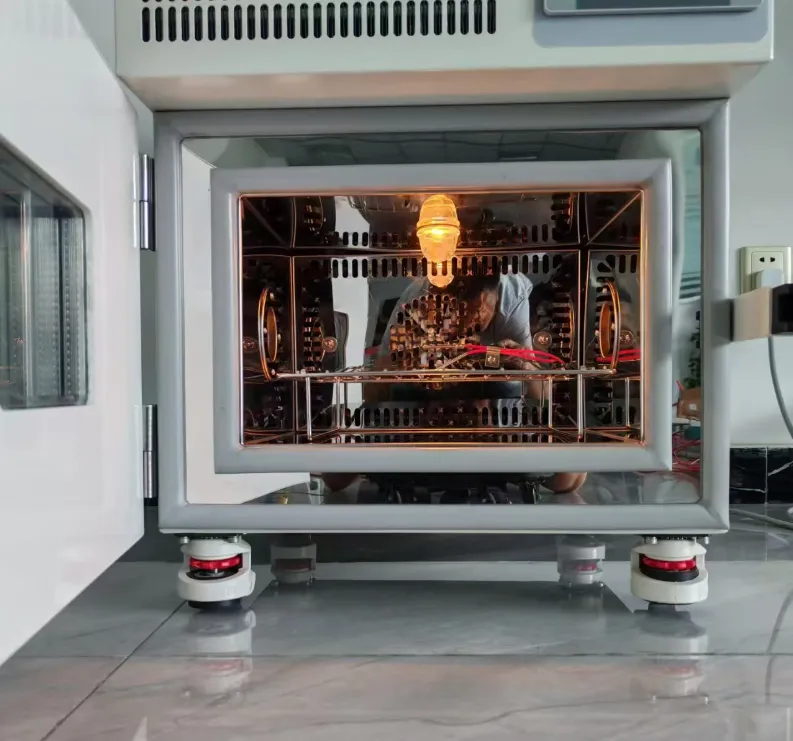
The following three questions represent the most frequent engineering and operational concerns raised by laboratory managers, quality engineers, and procurement specialists when specifying a Small Temperature Test Chamber.
1: How do I calculate the correct size of a Small Temperature Test Chamber for my test samples?
You must ensure that your specimen occupy no more than two-third of the internal volume, and that no sample is within 10 cm of any interior wall.
The one-third rule is based on airflow dynamics. For example, if you select a 36L Small Temperature Test Chamber, your total sample volume should not exceed 24 liters. Here is the step-by-step calculation method:
. Measure your DUT dimensions in centimeters: Length x Width x Height.
. Calculate single sample volume in liters: (L x W x H) / 1,000.
. Multiply by the number of samples to get total sample volume.
Additionally, maintain clearance for air circulation. The air return plenum is typically located on the back wall. Blocking this with a sample that is too tall will cause big temperature bias. For reliable results, always use the perforated shelves provided and never stack samples directly on the chamber floor.
2: How do I perform a temperature uniformity test (mapping) on my Small Temperature Test Chamber?
You will need a calibrated multi-channel data logger with at least 9 PT100 sensors
Here is the professional method:
. 9 PT100 temp sensor, calibrated to ±0.3°C accuracy
. Data logger with 50ms to 1 second sampling rate
. Chamber fixture or wire rack (non-metallic to avoid thermal conduction)
Test procedure:
1.Place the 9 sensors inside the empty chamber at these locations:
. 8 corners (each within 50mm of the wall
. Geometric center
2.Set the chamber to three setpoints you need: -40°C, +25°C, and +85°C
3.Allow 30 minutes of stabilization (soak time) at each setpoint.
4.Log temperature data for 30 minutes at each setpoint.
5.Calculate the uniformity as: (Highest temperature recorded among 9 points) minus (Lowest temperature recorded among 9 points).
Passing criteria: For a high-quality Small Temperature Test Chamber, uniformity should be ≤2.0°C. If your chamber exceeds 3.0°C uniformity, check for a blocked fan, a failed heater, or low refrigerant charge. Perform this test annually and after any relocation of the chamber.